한뉴픽
Asking Two Leaders: Interview with President In Sik Kim and Secretary General Kyung Seok Oh of the Daejeon Public Agency for Social Service (D-PASS) (No. 175 of 2025)

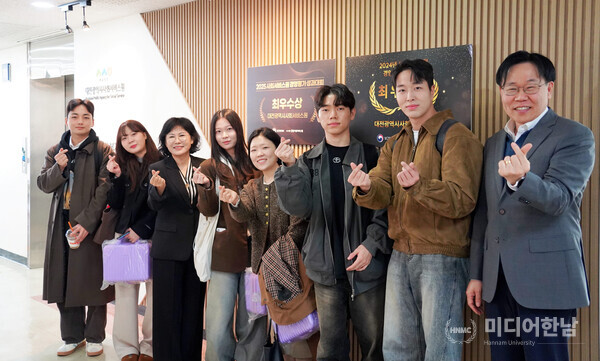
The Department of English Language and Literature is offering the course in a service-learning format. Through this course, the department has partnered with the Jungdo Ilbo and the Daejeon Public Agency for Social Service (D-PASS) to carry out the “Jung-Dae-Han Project.” This project enables students to apply the news-writing theories learned in class to real-life settings by participating in various D-PASS programs and writing articles based on their experiences. As part of this project, students Jun-Hyung Kim, Hee-Sang Park, Ye-Ji Shin, Min-Ji Jung, and Jae-Hyeok Choi visited D-PASS on November 6 to interview President In Sik Kim and Secretary General Kyung Seok Oh.
Question for President Kim:
What has been the most memorable or meaningful moment while leading D-PASS?
There have been many memorable moments, but the greatest fulfillment comes when citizens share how D-PASS has brought positive change to their lives. One particularly meaningful experience was when we launched the nation’s first Emergency Care Service for Persons with Disabilities at the Public Children’s Rehabilitation Hospital. When visiting the site, a guardian told me, “We’ve been able to regain our ordinary daily life,” and “I can trust this place with my child.” Those words were deeply moving.
As a result, citizen satisfaction was reflected in the national survey conducted by the Central Social Service Agency, where D-PASS received one of the highest scores in the country (95.2 points). We also achieved first place nationwide for two consecutive years in the Ministry of Health and Welfare’s management evaluation.
Does D-PASS offer any programs or opportunities for youth or university students?
Yes, we provide a variety of programs. For example, through the Youth Physical Health Promotion Service, we support young people struggling with obesity or poor physical fitness by offering customized exercise and nutrition programs. The Daily Care Service assists citizens in need of support—such as persons with disabilities, the elderly, or families of military service members—by providing daily care, meal services, and psychological support. Through such programs, young people can experience the value of care firsthand and learn the true essence of social welfare. In this way, D-PASS offers opportunities for youth to experience both sides of social service—as beneficiaries and as providers.
Could you share your thoughts on women’s leadership?
The greatest challenge has not been overcoming gender limitations, but breaking through the “wall of perception.” By this, I don’t mean the prejudice or binary distinction between men and women, but rather the social perception that emphasizes a woman’s leadership because she is a woman. The role of a leader, at its core, transcends gender. Therefore, I hope to serve as an example not of “how to become a leader,” but of “how to exist as one.”
Question for Secretary General Oh:
What led you to join D-PASS, and what sense of responsibility have you felt since taking on this role?
I used to be a businessman involved in various ventures. Over time, I built a professional relationship with President Kim and maintained a long-standing teamwork with her. When she moved to D-PASS, I naturally followed and joined her here.
People often talk about “social mix,” and that’s how I see our work—bringing together what might seem like conflicting values, management and welfare, to create synergy. I hope my contribution helps D-PASS continue to grow in that balance.
As Secretary General, recruitment must be one of your key responsibilities. What do you consider the most important qualities in a candidate, and why?
We no longer live in an era where academic background determines everything. What I focus on most are passion and attitude, because those two qualities reveal themselves the moment someone walks into an interview room. You can see it in their posture, tone, and facial expressions. Those who have truly prepared show them naturally. As J.Y. Park once said, to keep those qualities charged, you need to cultivate the habit of “doing things you dislike, consistently.” That’s the essence of shindok (愼獨)—being sincere and disciplined even when no one is watching. We look for people who live that way.
Final Question for Both:
What are your nearest and farthest goals at the moment?
President Kim: My short-term goal is to strengthen D-PASS’s role in the local community within my term and to create a workplace where employees feel a strong sense of fulfillment. In the long run, regardless of title or position, I wish to live as a citizen who can be a small source of strength to others. As long as time allows, I want to continue volunteering and be the first to reach out to neighbors in need.
Secretary General Oh: In the future, I plan to return to the path of entrepreneurship and start a new business. I want to study the fields I’m interested in more deeply and build my capabilities. Ultimately, my goal, both short- and long-term, is to become an entrepreneur who contributes to society with warmth.
Our Impressions of the Two Leaders After the Interview:
# President In Sik Kim: Passion, Vision, Engaging Dialogue
# Secretary General Kyung Seok Oh: Inclusiveness, Gentleness, Practical Insight
Choi Su Yeong / Reporter
정보관리부서 : 홍보팀
최종 수정일 : 2026-04-06